A place built on purposeto wire minds for the future.
We are raising the funds to secure a location and build the first campus for Human Adaptive Capacity — one place where every framework we have developed is put to work, from a child's first classroom to an executive's hardest decision.
Human capacity is critical infrastructure for the intelligence age
Every Campus Fund dollar is directed to the campus vision
The Vision
Section One
Capacity is built by environments.
So we are building one.
Programmes can teach a principle. Only a place can hold the conditions long enough for it to become who someone is.
Our research has shown that Human Adaptive Capacity is bounded, erodible and trainable — and that the conditions around a person decide which of those wins. Every school, workplace and household is already shaping the people inside it. Almost none were designed to.
The campus is the decision to design those conditions on purpose, across a whole life, in one place. A child, a teenager, a parent, a teacher and an executive team will learn in the same architecture, speak the same language and be measured on the same four tiers — so that what we learn at one stage of life strengthens every other.
Where capacity is cheapest to build.
Capacity is cheapest to build in childhood and most expensive to retrofit. The campus starts where the return is highest.
Where the whole system learns.
Children, families, educators and leaders share one site and one operating system, so the adults around a child grow alongside them.
Where the evidence is made.
The campus is also the Institute's research site: longitudinal, published and open about the results that do not support us.
The Site
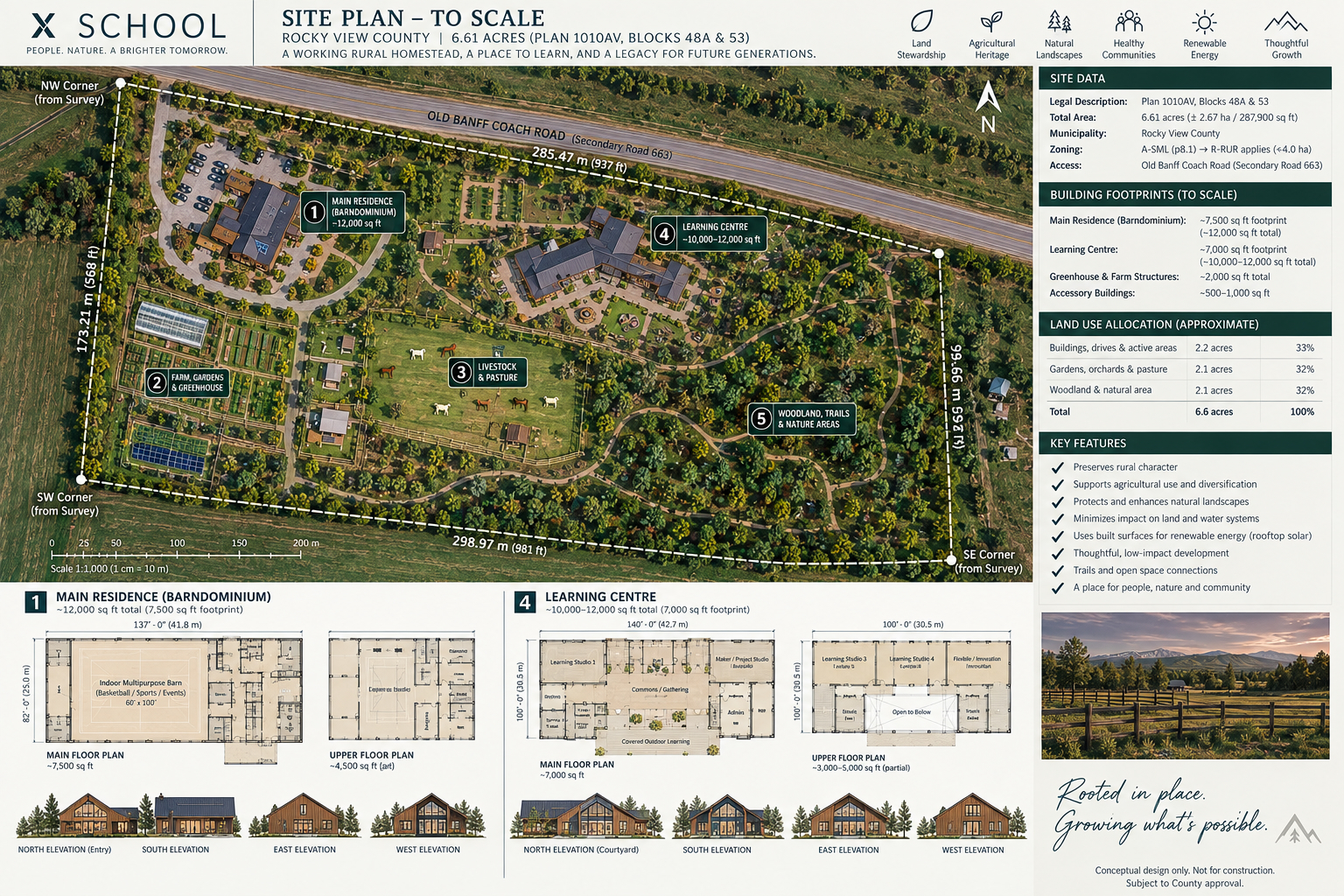
The First Site
Rocky View County, Alberta.
6.61 acres to begin.
A working rural homestead, a place to learn and a legacy for future generations — the first ground where the campus vision takes physical form.
Main Residence
A barndominium of about 12,000 sq ft, including an indoor multipurpose barn for sport, gatherings and events.
Farm, Gardens & Greenhouse
Growing spaces where children learn where food, effort and the seasons come from.
Livestock & Pasture
Daily animal care as a lesson in responsibility, patience and co-regulation.
Learning Centre
About 10,000–12,000 sq ft of learning studios, a commons and a covered outdoor classroom.
Woodland, Trails & Nature Areas
Restoration space and outdoor learning woven through the woodland.
6.61
Acres (2.67 ha) in Rocky View County, west of Calgary
5
Areas on one site, from farm to forest
10–12k
Sq ft Learning Centre at the heart of the site
⅔
Of the land kept for gardens, pasture and woodland
- Buildings, drives & active areas2.2 ac
- Gardens, orchards & pasture2.1 ac
- Woodland & natural area2.1 ac
Rooted in place. Growing what's possible.
Conceptual design only. Not for construction. Subject to Rocky View County approval.
The Campus
Section Two
One campus.
A whole life of capacity.
Designed as concentric rings around a single core: the SIMPLE™ operating system and the research that tests it.
Early Years & Family Commons
Where Being begins as co-regulation alongside a trusted adult. Parents and caregivers learn the same principles their children do.
xSchool Learning Studios
Learning environments where judgement, agency and adaptability are built alongside knowledge, not after it.
Youth Lab
The bridge from adolescence to adulthood: real decisions, real stakes and the practice of acting without certainty.
Leadership Residency
Where executive teams, educators and public leaders install the same architecture in the systems they run.
Research & Measurement Centre
The Institute's core: longitudinal studies, the four-tier measurement architecture and the Human Capacity Growth Score™.
Restoration Spaces
Margin designed into the site itself. Recovery is treated as infrastructure, not as a reward for finishing.
The campus described here is a vision. Location, scale, design and programming will be finalised through site selection, consultation and the Institute's board, and updated on this page as each phase is confirmed.
Every system is shaping people. This one will do it on purpose.
By design. Not by default.
The Frameworks
Section Three
Every framework.
One address.
The campus is where the full body of our work stops being a set of documents and becomes a set of conditions people live inside.
SIMPLE™
Six principles in two movements. Stability restores access to higher-order thinking; Agility directs it. Every space, schedule and ritual on campus is designed against these six.
The Four Postures
How capacity becomes observable in a child, a leader, a team or an institution. The same architecture across a life: the complexity scales, the requirement does not.
Four-Tier Measurement
Conditions, capacity, postures and outcomes, reported as a chain rather than in isolation, and composited into the Human Capacity Growth Score™.
Stewardship of Becoming
Treating the shaping of people as a governance object rather than a side effect. The campus will report who its conditions are helping people become.
The capacity to think clearly, exercise judgement, stay connected and adapt effectively under complexity, uncertainty and sustained load.
The Build
Section Four
From vision to ground.
Four phases, each reported publicly. Your gift today funds the first: securing the place where all of this will happen.
Secure the site
Location selection and acquisition, feasibility and the founding campaign.
Design with evidence
Architecture and landscape designed against SIMPLE™ and the four measurement tiers.
Build out
Construction and fit-out of learning, leadership, research and restoration spaces.
Open & measure
Programmes begin, and the longitudinal research that tests the whole model starts reporting.
Fields are not announced.They are built — somewhere.
Fund the Build
Section Five
Three ways to build it with us.
The campus can be funded by donors, by founding partners and by private investors. Every path leads to the same vision.
Give to the Campus Fund
Gifts of any size to our registered Canadian charity, directed to the campus vision.
- One-time or monthly giving
- Official donation receipts for eligible gifts
- Tribute, legacy and gifts of securities
Lead a founding gift
For foundations, families and organisations ready to make a defining contribution.
- Naming opportunities across campus spaces
- Multi-year pledges
- A seat in the founding circle
Invest in the site
Capital partnerships for land and buildout, for impact investors who want a return and a legacy.
- Site and infrastructure partnerships
- Structured separately from charitable gifts
- Investments are not eligible for donation receipts
Give
Build the humans capable of shaping what comes next.
Your gift becomes part of a place — the first campus designed from the ground up for Human Adaptive Capacity.
Online
One-time or monthly, using the form on this page. Your receipt is emailed to you.
By cheque
Payable to The Human Capacity Institute, marked "Campus Fund", mailed to our registered office: [full mailing address], Edmonton, Alberta.
Securities & legacy
Gifts of publicly traded securities and gifts in your will. Contact us and our Treasurer will guide the process.
Questions
Governance
Section Six
Stewardship of every dollar.
A registered charity with a long record of service, a new name and the same charitable commitments.
Angelo Fernando
Leads the Institute's board and the campus campaign.
James Cox
Oversees the Campus Fund, financial reporting and donation receipting.
- Name
- The Human Capacity Institute
Formerly the Sri Lanka Humanitarian Foundation of Canada (SLHFC)
- Status
- Registered charity, designated a Charitable Organization by the Canada Revenue Agency
- Registration no.
- 834168452RR0001
- Registered office
- Edmonton, Alberta, Canada
- Our heritage
- Founded to relieve poverty and provide humanitarian aid. Under its new name the foundation's six charitable mandates remain unchanged.
Our six charitable mandates
[Mandate one]
[Mandate two]
[Mandate three]
[Mandate four]
[Mandate five]
[Mandate six]
The future will be more intelligent. It should also be more human.
By design. Not by default.